RARE ONE DIME Sells for Over $1,000,000 – Do You Have It?
Have you ever looked at the loose change in your cup holder and wondered if you were staring at a fortune? It sounds like a clickbait fantasy, but in the world of professional numismatics (coin collecting), it is a stone-cold reality. Recently, headlines have been set ablaze by the news of a rare Roosevelt Dime selling for over $1,000,000.
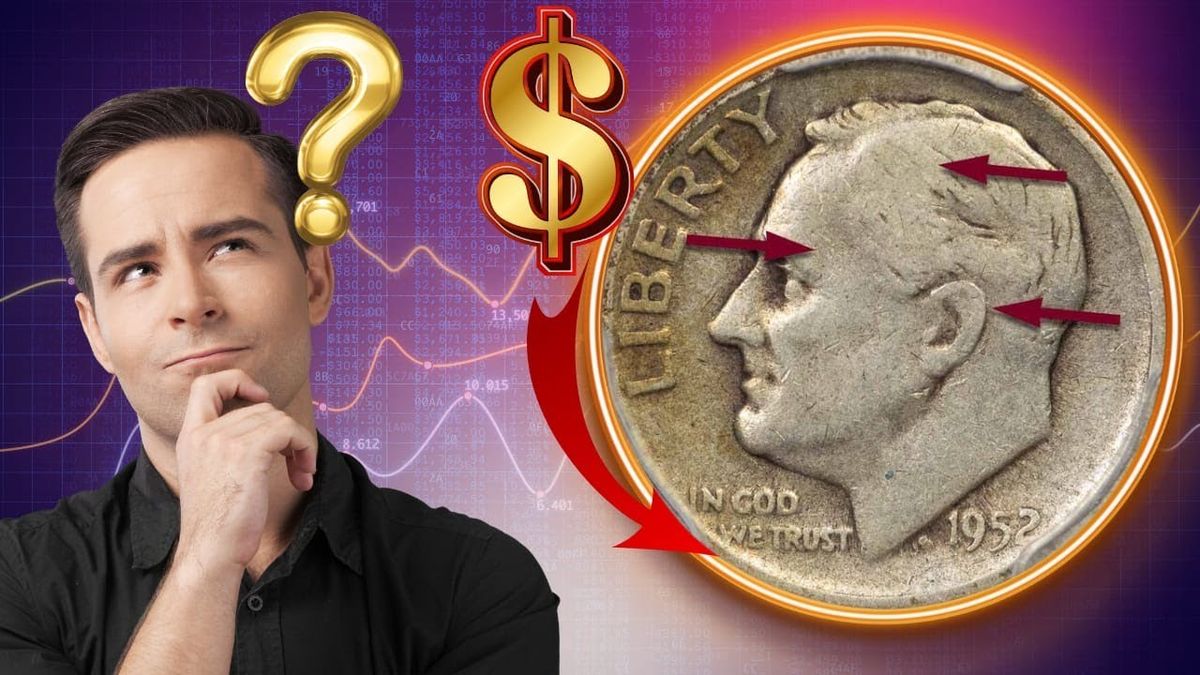
The image above features a 1952 Roosevelt Dime, highlighted with mysterious arrows pointing to the President’s hair and forehead. But is the 1952 dime really the million-dollar winner, or is there a deeper secret hidden in the history of the ten-cent piece?
In this ultimate guide, we will break down the myths, the million-dollar sales, and exactly what you need to look for to see if you’re holding a retirement fund in the palm of your hand.
1. The Million-Dollar Mystery: Is it the 1952 Dime?
To be intellectually honest, we have to address the “elephant in the room.” While the image features a 1952 dime, most 1952 dimes—even in decent condition—are worth about $2.00 to $5.00 due to their silver content.
So, why the million-dollar headline? In the coin world, “Million-Dollar Dimes” usually refer to ultra-rarities like the 1894-S Barber Dime (of which only 24 were minted) or the legendary 1975 No-S Proof Roosevelt Dime.
However, the 1952 dime in the photo is being used as a “placeholder” for a very real phenomenon: The Error Hunt. Collectors are currently obsessed with finding “Die Cracks” and “Lamination Errors” on mid-century silver dimes that could skyrocket their value.
The Arrows: What are they pointing at?
The red arrows in the image point to three specific areas on Roosevelt’s head:
-
The Forehead/Hairline: Look for “Spiked Head” die cracks.
-
The Crown of the Head: Look for “Die Chips” or “Cud” errors.
-
Behind the Ear: Look for “clash marks” where the reverse design (the torch) accidentally bled through to the front.
2. The Real Million-Dollar Dimes: The “Holy Grail” List
If you want to find a coin that actually fetches six or seven figures, you need to know the specific dates and mint marks that make history.
The 1975 “No S” Proof Roosevelt Dime
This is the closest modern relative to a million-dollar dime. Only two are known to exist. Proof sets from 1975 were supposed to have an “S” mint mark (San Francisco). Two sets were discovered where the dime was missing the “S”. One sold recently for over $500,000, and experts believe if one went to auction today in a bidding war, it could easily approach the $1,000,000 mark.
The 1894-S Barber Dime
This is the king of dimes. Legend has it the Mint Superintendent struck only 24 of them to balance the books, and gave three to his daughter. One sold for $1.9 million in 2016. While you won’t find this in a grocery store, they are sometimes found in “junk” silver bins at estate sales.
3. How to Spot a High-Value 1952 Dime
Even if your 1952 dime isn’t worth a million, it could still be worth hundreds or thousands if it meets specific “Full Band” criteria.
The “Full Bands” (FB) Designation
Turn the coin over and look at the torch on the back. You will see horizontal bands at the top and bottom of the torch.
-
Standard Strike: The bands are blurry or merged.
- Full Bands (FB): The lines are perfectly separated.
A 1952 dime with “Full Bands” and a high grade (MS67 or MS68) can sell for $1,000 to $3,000.
Major Errors to Look For:
-
Doubled Die Obverse (DDO): Look at the words “IN GOD WE TRUST.” If the letters look like they have a “shadow” or were stamped twice, you’ve found a winner.
-
Clipped Planchet: If the coin looks like a “bite” was taken out of the side during the minting process.
-
Off-Center Strike: If the image of Roosevelt is shifted to one side, leaving a blank crescent of silver.
4. The “Silver Rule”: Why 1964 is the Magic Year
Regardless of errors, you should never spend a dime dated 1964 or earlier. * 1946–1964: These dimes are 90% silver. As of 2026, the “melt value” alone is usually 15–20 times the face value.
-
1965–Present: These are “clad” coins made of copper and nickel. Unless they have a major mint error, they are only worth ten cents.
5. Summary Table: What to Check Right Now
| Coin Feature | What to Look For | Potential Value |
| Year: 1975 | No “S” mint mark on a Proof coin | $500,000+ |
| Year: 1982 | No “P” mint mark | $100 – $300 |
| Year: 1952 | “Spiked Head” Die Crack (as seen in photo) | $50 – $200 |
| Any Pre-1965 | 90% Silver Content | $2.00+ (Melt Value) |
| Reverse Side | “Full Bands” on the torch | $500 – $3,000 |
Final Verdict: Do You Have It?
The chances of finding a million-dollar coin in your pocket are slim, but the chances of finding a $50 or $100 error are actually quite high if you know where to look. The man in the photo is thinking about the “what if”—and you should too.
Next Step: Grab a magnifying glass or use your phone’s macro camera lens. Check the dates on your dimes. If you see a 1952 with those strange lines on the head, or a 1975 without a mint mark, don’t clean it! Cleaning a rare coin can destroy 90% of its value. Instead, take it to a local reputable coin dealer for an appraisal.
Would you like me to help you identify a specific mint mark or explain how to get a coin professionally graded by PCGS or NGC?