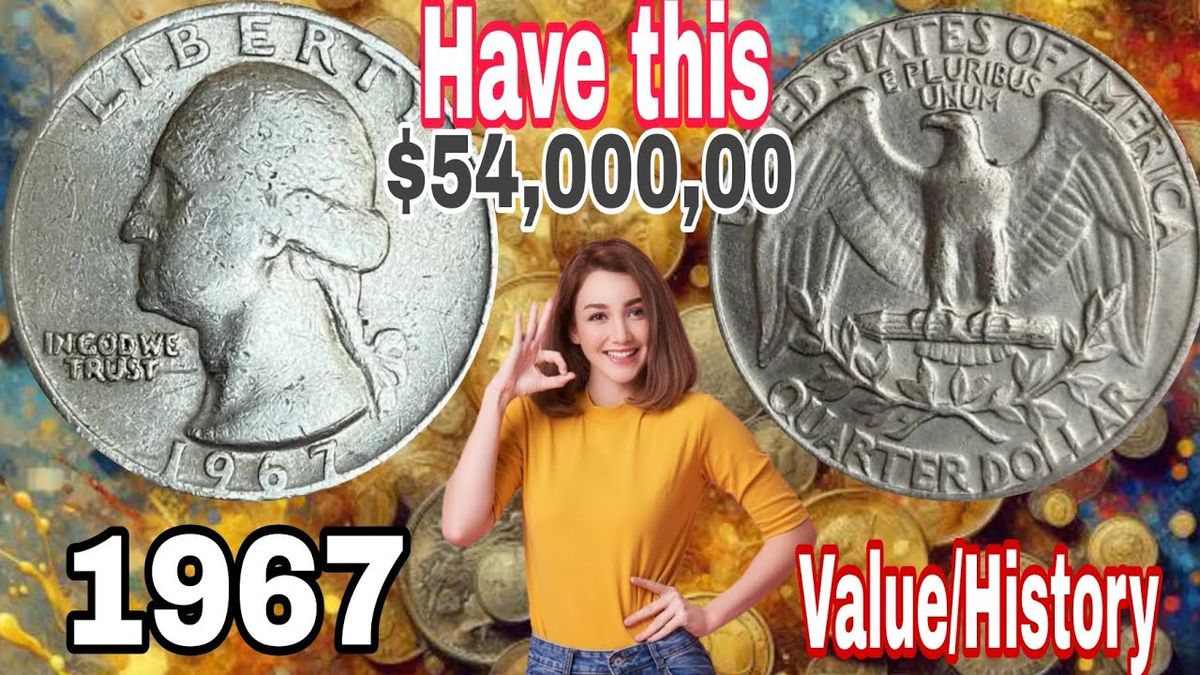
1967 Washington Quarter Dollar value and history:: How Much is it worth Today?
1. Historical Context: The Era of Change
The year 1967 was a pivotal moment for the United States Mint. The country was in the middle of a massive transition in its coinage.
-
The End of Silver: Just two years prior, in 1965, the Mint had officially transitioned away from 90% silver quarters due to rising silver prices and a national coin shortage. The 1967 quarter is composed of a clad material: a pure copper core sandwiched between layers of 75% copper and 25% nickel.
-
The “No Mint Mark” Mystery: To discourage collectors from hoarding coins by mint location during the shortage, the U.S. Mint removed all mint marks (like “D” for Denver or “S” for San Francisco) from 1965 to 1967. This means every 1967 quarter looks like it was minted in Philadelphia, even if it wasn’t.
-
Special Mint Sets (SMS): Because the Mint was focused on producing circulating coins to end the shortage, they did not produce traditional “Proof” sets for collectors in 1967. Instead, they released Special Mint Sets (SMS). These coins have a better strike and higher luster than regular quarters but aren’t quite as mirror-like as traditional proofs.
2. How Much is a 1967 Quarter Worth Today?
The value of a 1967 quarter is determined almost entirely by its condition (grade) and the presence of errors.
Standard Circulated Value
Most 1967 quarters you find in your wallet today have been heavily used. In this condition (Fine to Extremely Fine), they are generally only worth their face value of 25 cents.
Uncirculated (Mint State) Value
If you have a 1967 quarter that looks brand new with its original “mint bloom” (luster), its value increases:
-
MS-63 to MS-65: $1 to $10.
-
MS-66: $20 to $50.
-
MS-67: $150 to $600.
-
MS-68: This is where the big money is. A 1967 quarter graded MS-68 by a professional service like PCGS or NGC can sell for $3,000 to $8,000 at auction.
Special Mint Set (SMS) Value
Coins from the Special Mint Sets are valued separately:
-
Standard SMS: $2 to $10.
-
Cameo/Ultra Cameo: These are SMS coins where the design (Washington’s head) looks “frosted” against a shiny background. These can fetch $500 to $2,000 depending on the depth of the contrast.
3. Rare 1967 Error Quarters to Look For
Errors are the “holy grail” for 1967 quarter collectors. Because of the high production volume that year (over 1.5 billion struck), several mistakes made it out of the mint.
| Error Type | What to Look For | Potential Value |
| Double Die Obverse (DDO) | Look for doubling in the letters of “LIBERTY” or “IN GOD WE TRUST.” | $50 – $500 |
| Struck on Wrong Planchet | A quarter struck on a penny or nickel blank (it will be smaller, thinner, or a different color). | $300 – $2,000+ |
| Off-Center Strike | The design is shifted, leaving a crescent of blank metal on one side. | $20 – $300 |
| Clipped Planchet | A piece of the edge is missing in a clean “bite” shape. | $10 – $100 |
| “Spitting Eagle” | A die crack that looks like a line coming out of the eagle’s mouth on the reverse. | $10 – $30 |
4. How to Identify a High-Value Coin
If you think you’ve found a winner, look for these three things:
-
Luster: Does the coin still have a “spinning” light effect when you rotate it under a lamp?
-
Contact Marks: Are there many scratches or “bag marks” on Washington’s cheek? The fewer the marks, the higher the grade.
-
The Rim: Check the edge. If the coin is thick and the “reeding” (the ridges) is sharp and deep, it might be an SMS strike or a high-grade business strike.
Summary of Specifications
-
Designer: John Flanagan
-
Composition: 91.67% Copper, 8.33% Nickel
-
Weight: 5.67 grams
-
Diameter: 24.3 mm
Note: Beware of “fake” errors on sites like eBay. Many sellers list dirty or damaged coins as “rare errors” for thousands of dollars. Always look for coins certified by PCGS or NGC if you are buying for investment.
Would you like me to help you identify specific markings on your coin to see if it might be an error variety?