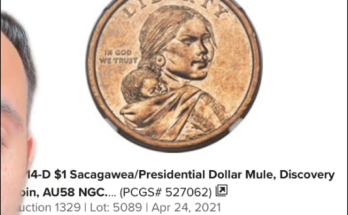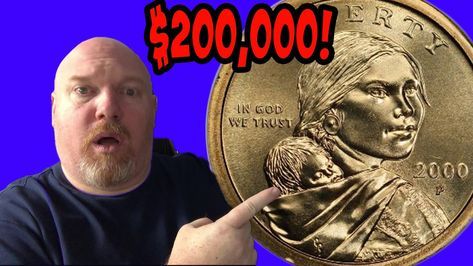
While most Sacagawea dollars are worth only their face value of $1, certain rare errors and specialized varieties can reach staggering values at auction. The most famous and valuable “Holy Grail” of this series is the 2000-P Sacagawea/Washington Quarter Mule, which has been valued at up to $250,000.
Below is a breakdown of why some Sacagawea dollars are worth a fortune and how to identify them.
1. The $250,000 Legend: The 2000-P “Mule” Error
The primary reason you see headlines about $200,000 Sacagawea dollars is a rare minting mistake known as a “Mule.”
-
The Error: A “mule” occurs when the obverse (front) of one coin is accidentally paired with the reverse (back) of another. In this case, the George Washington head from a state quarter was struck on the front of a gold-colored Sacagawea dollar planchet.
-
The Value: Only about 18 verified examples of this specific error are known to exist. Because of their extreme scarcity, high-grade specimens have sold for between $100,000 and $200,000+ at major auctions.
-
How to Spot It: Look for George Washington’s face on a gold-colored coin instead of the image of Sacagawea.
2. The “Cheerios” Dollar Variety
In 2000, the U.S. Mint partnered with General Mills to place 5,500 Sacagawea dollars in boxes of Cheerios cereal as a promotion.
-
The Difference: Collectors later discovered that these specific coins used a “prototype” reverse die with enhanced detail in the eagle’s tail feathers. Standard circulation pennies have smooth tail feathers, while Cheerios dollars have sharp, crisp diagonal lines.
-
The Value: High-grade examples can sell for $5,000 to $25,000+.
-
How to Spot It: Use a magnifying glass to check the eagle’s tail feathers on the back. If they have thick, defined ridges, you might have a Cheerios dollar.
3. The “Wounded Eagle” Variety
This is a popular die-error variety found on 2000-P Philadelphia-minted dollars.
-
The Error: A raised die gouge creates three distinct lines across the eagle’s belly and wing, making it look as though it was pierced by an arrow.
-
The Value: While more common than the Mule, a “Wounded Eagle” in Mint State condition (MS68) has an auction record of $7,200. Even lower-grade circulated versions can fetch $100 to $500.
-
How to Spot It: Inspect the eagle’s torso on the back for raised, jagged lines that cut through the feathers.
4. Other High-Value Errors to Look For
-
Goodacre Presentation Specimens: Struck on specially burnished planchets for the coin’s designer, Glenna Goodacre, these have a unique “proof-like” appearance and can be worth $1,000 to $5,000.
-
Wrong Planchet Errors: Occasionally, the Sacagawea design was struck on a leftover silver-colored planchet meant for a Susan B. Anthony dollar. These can be worth over $15,000.
-
Missing Edge Lettering: On later Native American dollars (2009 and beyond), the date and mint mark are on the edge. If the edge is smooth and missing this info, it can be worth $100 to $1,000.
Summary Checklist for Collectors
Most Sacagawea dollars in your pocket are simply worth $1, as millions were minted for general circulation. However, always keep an eye out for these specific “mints gone wrong” that turn common change into life-changing treasures.
Would you like me to analyze a photo of a coin you have, or help you find a local coin dealer to authenticate a potential discovery?