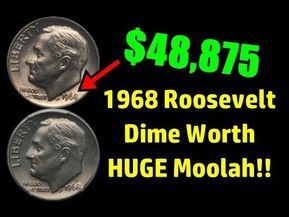
While most 1968 dimes found in circulation today (those struck at the Philadelphia mint with no mint mark, or the Denver mint with a ‘D’ mint mark) are worth only face value or slightly more in pristine condition, a tiny, accidental batch struck that year achieved legendary status and record-breaking prices, with one example selling for $48,875. The key to this life-changing discovery is knowing where to look and, most importantly, what you are looking for.
🔍 The Million-Dollar Mistake: The “No-S” Proof Dime
In 1968, the United States Mint in San Francisco (S) was responsible for producing all proof coins. Proof coins are specially struck, high-quality, mirror-like coins made for collectors and mint sets, not for general circulation. They were always supposed to carry an “S” mint mark.
The monumental error occurred when a small number of proof dimes were struck using a die that was incorrectly prepared in Philadelphia and shipped to San Francisco without the ‘S’ mint mark being punched onto it.
-
The Rarity: Only a few dozen examples of the 1968 No-‘S’ Proof Dime are known to exist in all grades combined.
-
The Value: This makes it one of the rarest and most valuable Roosevelt dimes. A coin graded Proof-68 (PR68), meaning near-perfect, achieved a realized auction price of $40,250 in 2008 and $21,150 in 2015. The record price for this coin was nearly $49,000 for an MS68 grade.
-
The Clue: The coin in question will have a mirror-like finish—the signature of a proof coin—but will have no mint mark above the date ‘1968’.
While the “No-S” Proof Dime is the biggest prize, other versions of the 1968 Dime hold value for different reasons.
🥈 Circulated Value: The Clad Composition
The 1968 dime belongs to the clad-era of U.S. coinage, which began in 1965. This means that the vast majority of 1968 dimes found in pocket change—those struck for circulation at Philadelphia (no mint mark) or Denver (‘D’ mint mark)—are made of a copper core clad with a copper-nickel mixture.
-
Face Value Coins: A heavily circulated 1968-D dime is typically worth between $0.15 and $0.35. Most circulated examples hold only face value plus a small dealer markup.
-
Uncirculated Value: However, finding a 1968-D in pristine, uncirculated condition (Mint State, or MS) can still bring in a profit. An MS67 example of the 1968-D can sell for around $45, with the highest grades fetching up to $165.
💡 The Common Errors That Boost Value
Beyond the legendary “No-S” Proof, collectors are always searching for smaller, more common minting anomalies in the 1968 dimes, which can be found in regular circulation and still be worth significantly more than ten cents:
-
Doubled Die Obverse (DDO): This error occurs when the coin is struck twice with a slight shift in position. For the 1968 Roosevelt Dime, a DDO has been reported and can be worth around $60 in some cases. Look closely at the lettering in “LIBERTY” and “IN GOD WE TRUST” for a faint ghosting or doubling.
-
Clipped Planchet: A coin that is not perfectly round because the blank metal disc (planchet) was incorrectly cut before striking. This makes the coin look like it has a clean crescent missing from the edge and is extremely desirable to error collectors.
-
Strike-Through Errors: These happen when foreign material (like grease or a thread) falls onto the coin blank during striking, preventing the design from fully forming in that spot.
-
Off-Center Strike: If the coin blank is slightly misplaced when it’s struck, the design will be off-center, making the coin valuable based on how much the image is skewed.
The key takeaway is clear: while finding the $48,875 dime requires checking an official proof set, checking your everyday change for any 1968 dime is still a profitable venture if you train your eye to spot the distinctive characteristics of error coins.
Would you like me to provide a step-by-step guide on how to visually check a coin for a Doubled Die Obverse (DDO) error?